

Silence, Stone, and the Long View of Time
Hidden deep within the wooded folds of the Ernici Mountains, the Certosa di Trisulti is not a place one simply “stops by.” It is a destination that asks for intention, time, and a willingness to step outside ordinary routes. Reaching it already feels like a transition: roads narrow, forests thicken, and the landscape begins to quiet down long before the monastery appears.
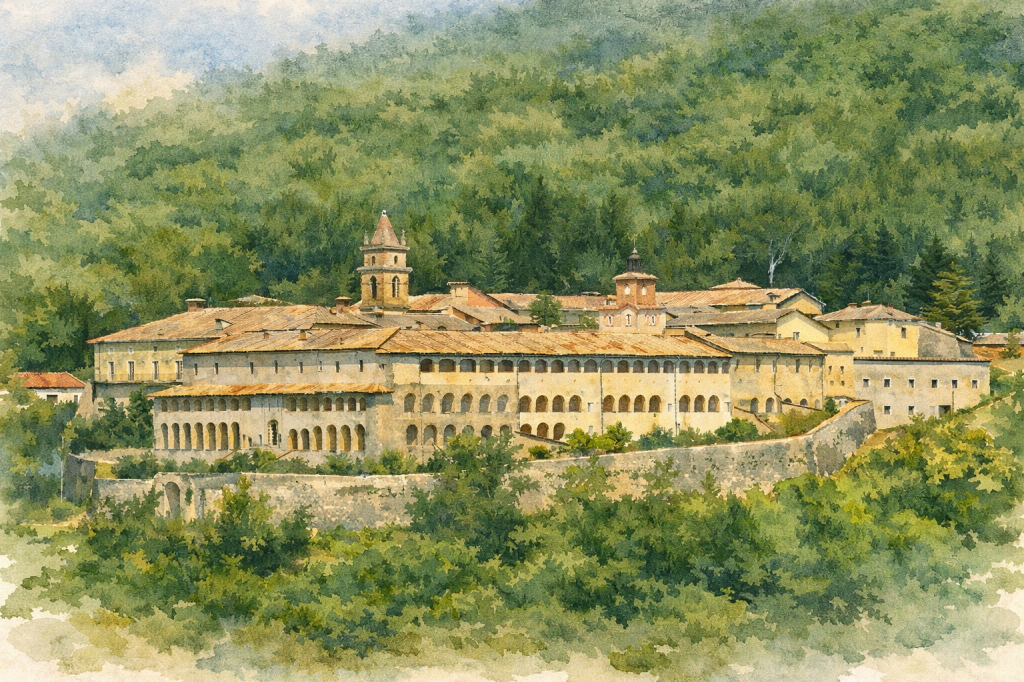
Founded in the early 13th century and entrusted to the Carthusian order, Trisulti was conceived as a place of withdrawal in the most literal sense. Carthusian life was built around silence, separation, and contemplation, and the architecture of the certosa reflects this philosophy with remarkable coherence. Stone corridors, austere façades, and carefully proportioned spaces do not seek to impress; they seek to endure.
What makes Trisulti unique is not only its history, but its setting. The monastery seems almost suspended between forest and sky, overlooking valleys that stretch far beyond the immediate view. Here, nature is not decorative but structural: the surrounding woods, the changing light, the seasonal rhythms all form part of the experience. Even today, the atmosphere remains one of rare stillness, a condition increasingly difficult to find so close to Rome.
Historically, Trisulti was also a place of knowledge. Its pharmacy, renowned throughout central Italy, produced herbal remedies using plants gathered in the surrounding mountains. The library and internal spaces speak of a world where learning, spirituality, and observation of nature were inseparable. Visiting Trisulti is therefore not only a visual experience, but an encounter with a different way of organising life and time.
Accessing Trisulti independently is not straightforward. There are no direct trains, public transport connections are limited, and the final approach requires familiarity with mountain roads. This remoteness is precisely what has preserved its character, but it also means that for most travellers it remains inaccessible, despite being geographically close to Rome.
Within QuodLibet Private Journeys, Trisulti is approached as part of a broader itinerary through monastic and mountainous Lazio, where the journey itself prepares the visitor for the place. The road, the landscape, the gradual ascent, and the surrounding villages all contribute to a sense of progression. Arrival is never abrupt; it feels earned.

A visit to the Certosa di Trisulti is not about ticking off a landmark. It is about entering a space shaped by centuries of restraint and intention, and allowing that space to set the pace. For those who value depth over accumulation, it is one of the most singular experiences offered by the region—and one that cannot be replicated without the right context, timing, and access.
In this sense, Trisulti perfectly reflects the spirit of QuodLibet Journeys: places that reveal themselves slowly, reached by paths less travelled, and remembered long after the road back has begun.





 Quodlibet Private Journeys