
From the Apennines to the Adriatic
Campo Imperatore, the Gran Sasso, and the Coast of the Trabocchi
Campo Imperatore & Gran Sasso d’Italia
One of the least intuitive facts about this journey is its proximity. In little more than an hour from Rome, the road climbs steadily toward Campo Imperatore, entering a landscape that feels radically removed from central Italy as it is usually imagined. Altitude replaces density, horizontality replaces enclosure, and the experience shifts almost imperceptibly from movement to immersion.
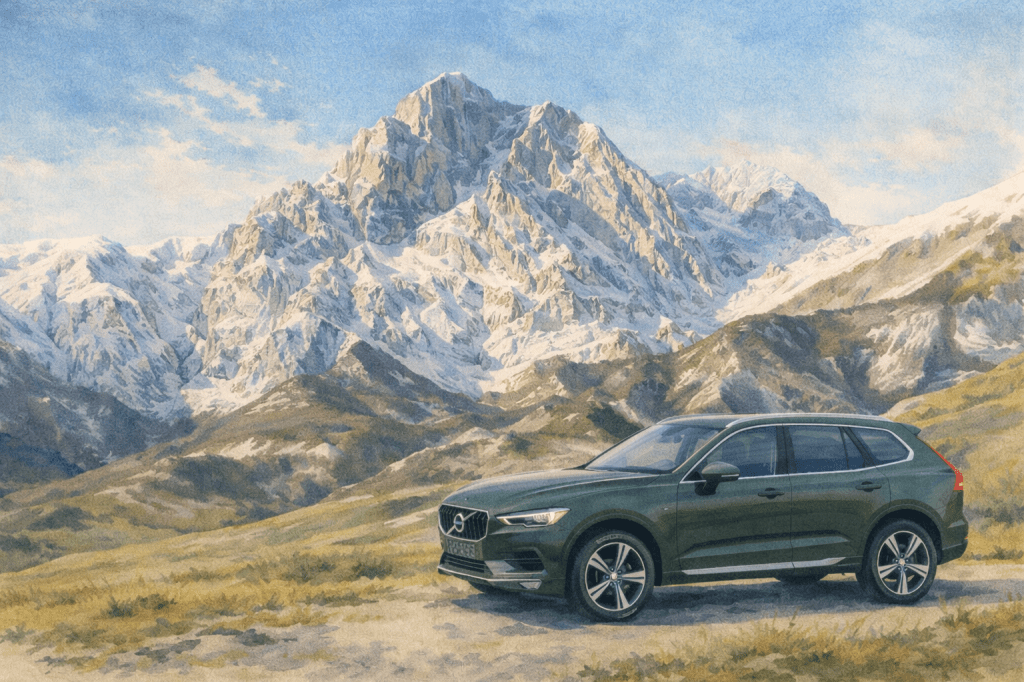
Campo Imperatore is often called the Tibet of Italy, not as a metaphor for exoticism, but for its geography. At over 1,600 meters above sea level, it is one of the largest high-altitude plateaus in Europe, a vast open space surrounded by peaks, where the scale of the landscape overwhelms any human reference. Here, the sky feels closer, the wind more present, and the light sharper, especially in the colder months when snow and ice flatten the terrain into near abstraction.
At the heart of this environment rises the Gran Sasso d’Italia, the highest mountain massif in central Italy, dominated by the Corno Grande. Its presence organises the entire region, not only physically but culturally. For centuries, shepherds, travelers, scientists and soldiers have crossed and studied these mountains, drawn by their isolation and severity. The plateau has been a place of transhumance, where flocks moved seasonally between mountain and plain, shaping paths that still structure the territory today.
Campo Imperatore has also played an unexpected role in modern history. During the Second World War, it was here, in the remote mountain hotel, that Benito Mussolini was held prisoner before his dramatic rescue. The episode adds another layer to a landscape already dense with meaning, reinforcing the sense that this is a place where isolation has always mattered.
Cinema, too, has been drawn to Campo Imperatore. Its openness and lack of visual noise have made it a natural setting for films seeking elemental, almost metaphysical backdrops. The plateau does not frame scenes; it absorbs them.
Stone Villages and Mountain Continuity
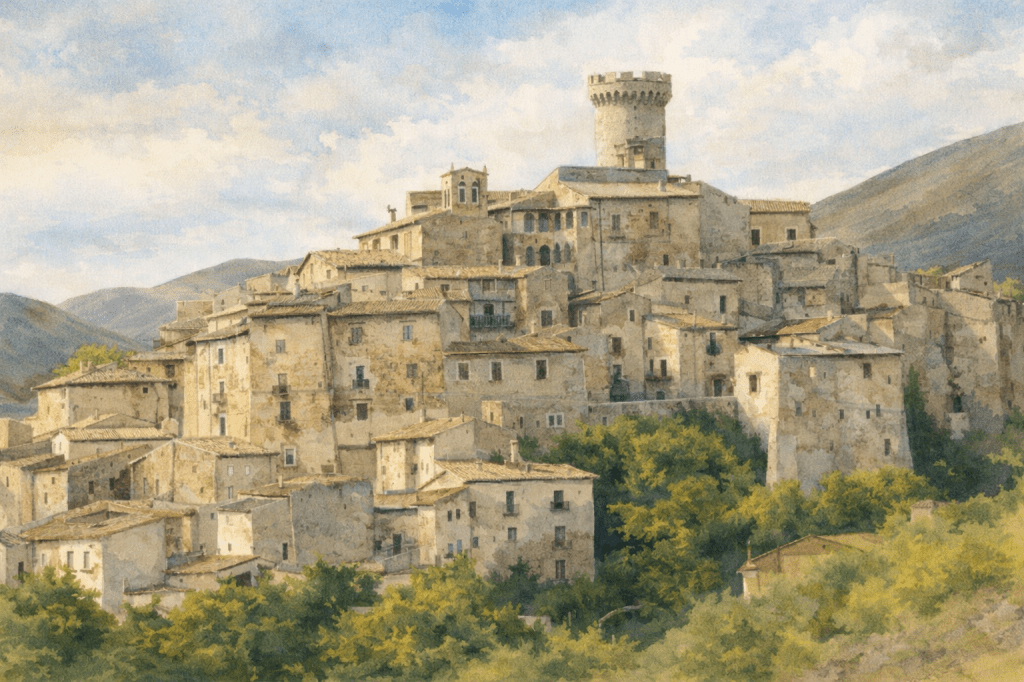
Descending from this high-altitude world, the journey reaches Santo Stefano di Sessanio, a village that seems to condense the logic of the mountain into architecture. Built entirely of local limestone, compact and inward-looking, Santo Stefano reflects a society shaped by scarcity, climate, and long winters. For centuries, it was a key center of the wool trade, connected to the great pastoral economy of Abruzzo.
Walking through the village today feels less like visiting a site and more like entering a structure that has never been redesigned. Streets are narrow, spaces compressed, and views carefully controlled. Nothing here feels accidental. The village does not display itself; it holds together.
Toward the Teramano and the Sea
From the Gran Sasso area, the road begins a long and gradual descent into the Teramano and toward the Adriatic. This transition is one of the great strengths of the itinerary. Mountain rigidity softens into hills, forests give way to cultivated land, and the sense of altitude slowly dissolves into openness.
The Trabocchi Coast and Its Cuisine
The arrival on the coast introduces yet another radical shift. Along the Costa dei Trabocchi, the sea is marked by wooden fishing structures suspended over the water, connected to land by narrow walkways. The trabocchi are both machines and architectures, built to fish without boats, adapting ingeniously to currents and tides. Today, many have become small restaurants, where dining happens literally above the sea.
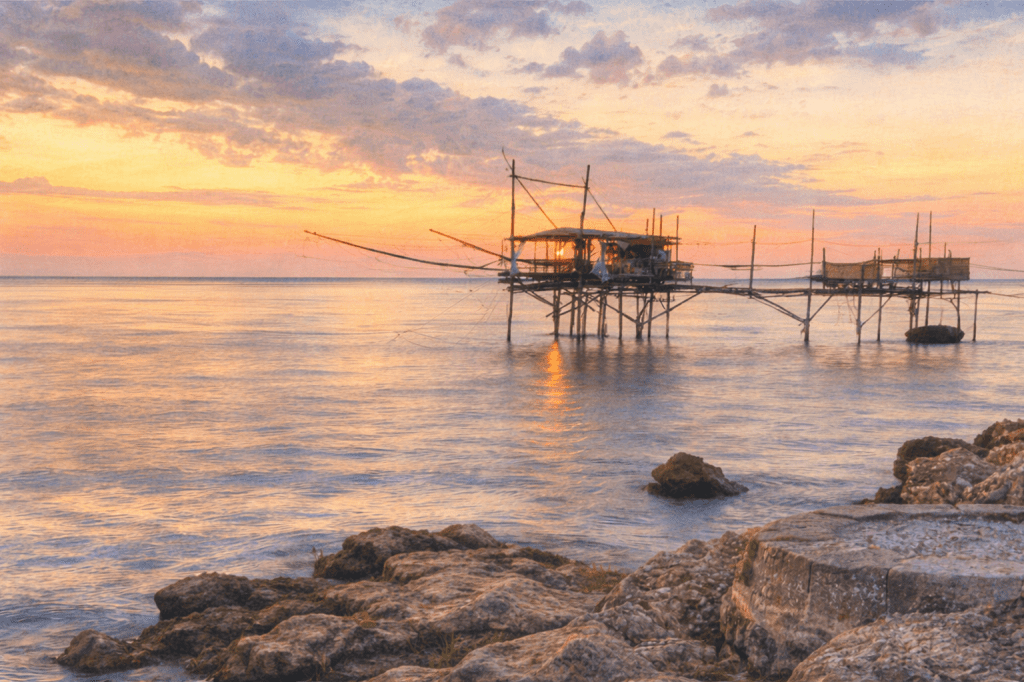
Eating on a trabocco is inseparable from the place. The sound of waves beneath the floor, the movement of the structure, and the simplicity of the cuisine—anchored in fresh fish and local tradition—create an experience that cannot be detached from its setting. It is one of the most distinctive culinary landscapes in Italy, still largely outside international tourism circuits.
Depending on timing and interest, a brief stop in Pescara can add a further layer. As a modern Adriatic city, Pescara offers contrast: urban coastline, promenades, and everyday life unfolding at sea level after the silence of the mountains. Even a short pause helps reframe the journey, connecting altitude to coast through lived continuity rather than spectacle.
What makes this itinerary exceptional is not only its variety but its coherence. Few places in Italy allow one to move, in a single day, from one of the highest and most open landscapes of the Apennines to the sea, passing through villages that have remained structurally intact for centuries. Distances are moderate, but the sense of travel is immense.
Within QuodLibet Private Journeys, this route is approached as a continuous experience shaped by light, weather, and rhythm. Campo Imperatore is not treated as a viewpoint, but as an environment; the villages are not stops, but condensations of history; the coast is not a destination, but a release.
This is a journey for travellers drawn to places that have not been simplified, where geography still imposes itself and access still matters. It offers one of the most powerful and least expected readings of central Italy—one that remains vivid precisely because it stays slightly apart.
What the Abruzzo Tours offers
- A private day trip from Rome for two guests
- A soft, carefully paced approach to the Abruzzo area
- Private transportation in a comfortable vehicle
- A Roman host who accompanies you throughout the day
- Flexibility and attention to rhythm rather than rigid schedules
Price
Full day tour: 900, EUR
Half day tour: 550,00 EUR
The tour includes: transportation with driver, fuel and pay-tools costs. The tour does not include food, extra excursions and entrance tickets to attractions
Who the Abruzzoprivate journey is for
This experience is ideal for couples and travellers who:
- value comfort, conversation and quiet moments
- enjoy iconic places when they can be experienced with time and perspective
 Quodlibet Private Journeys