
Coastal Latium from Rome
From Rome to the Sea, Through Myth, Landscape, and Memory
The coastline south of Rome is one of those places that reveals how closely geography, history, and imagination are woven together. Close in distance, yet rich in layers, it offers an ideal journey for traveling slowly while seeing deeply. From the Appian Way to the sea, from classical ruins to coastal villages, this route unfolds as a continuous landscape rather than a sequence of isolated stops.
Our full-day Lazio Coast Private Journey is designed precisely for this kind of exploration: covering much without rushing, moving easily between places that are otherwise difficult to reach without a car, and allowing time for context, conversation, and discovery. The cost for the full-day journey is €1100, reflecting the length, complexity, and care involved in shaping the day.
Leaving Rome Along the Appian Way
The journey begins by leaving Rome along stretches of the ancient Via Appia, one of the oldest and most evocative roads of the Roman world. This route was not only a means of transport, but a cultural axis that connected the city to the south, shaping landscapes that would later inspire painters, travelers, and writers.
In the late nineteenth century, artists and intellectuals traveling through Italy considered this area part of the extended Grand Tour. The wide horizons, changing light, and contrast between cultivated land and open sky appear in the works of painters drawn to these “Roman countrysides,” suspended between antiquity and modern life.
Terracina and the Temple Above the Sea
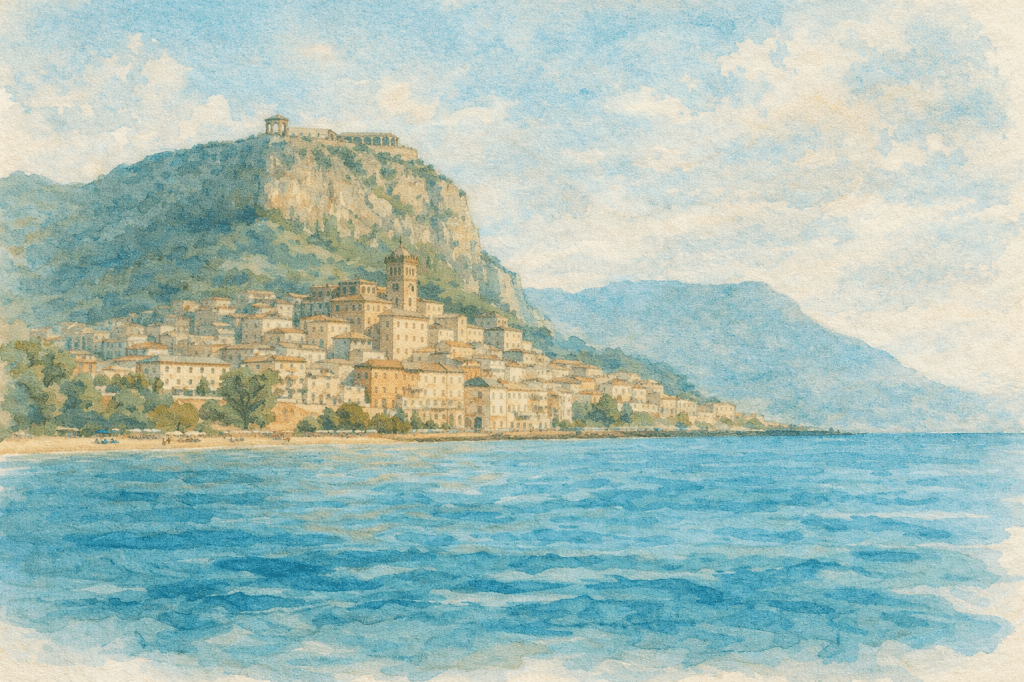
As the road approaches the coast, the landscape opens toward Terracina, where history rises dramatically above the sea. High on the cliff stands the Temple of Jupiter Anxur, a powerful reminder of Roman presence and control over land and water.
From here, the view stretches across the coastline, offering one of the most striking perspectives in the region. The temple, the sea below, and the road itself form a single visual narrative, one that has remained largely unchanged for centuries.
The Promontory of Circe and the World of Myth
Continuing south, the land curves around the Circeo Promontory, a place where geography and myth converge. According to ancient tradition, this was the realm of Circe, the enchantress encountered by Ulysses during his wanderings.
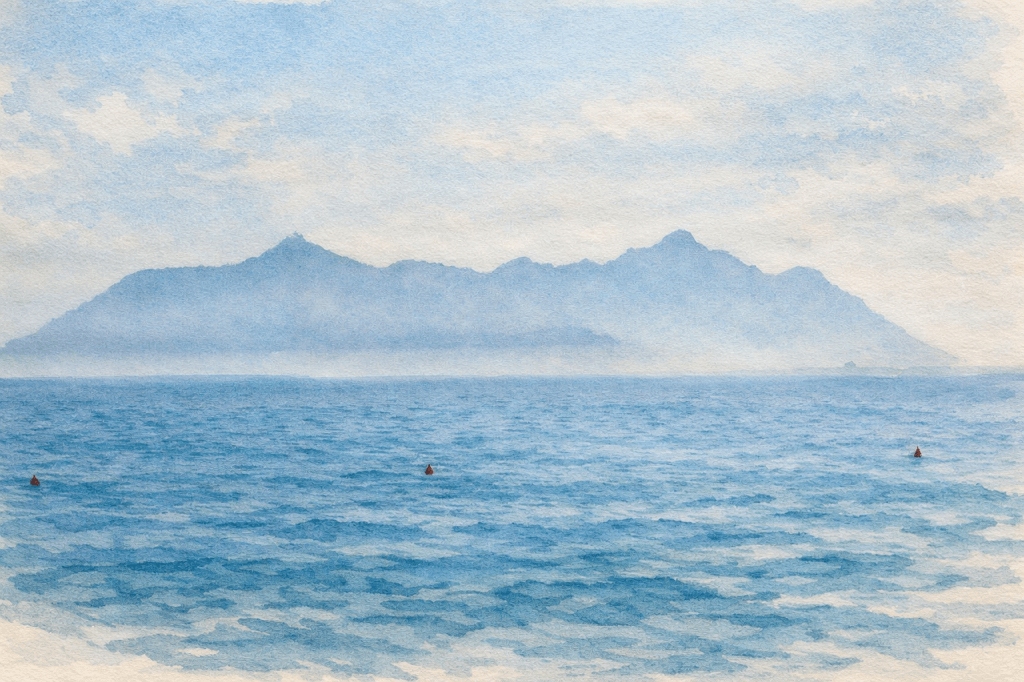
Seen from the right angle, the promontory appears almost isolated from the mainland, rising sharply from the plain. From its heights, the view toward the Pontine Islands is wide and unforgettable, especially on clear days when the sea seems to dissolve into light. It is one of those moments where landscape alone tells a story.
Nearby, towns such as San Felice Circeo and Sabaudia offer different readings of the same territory: one rooted in ancient settlement, the other shaped by twentieth-century urban ideals, both framed by dunes, forests, and the open sea.
Sperlonga, White Stone and the Mediterranean
Further along the coast lies Sperlonga, a town of white houses, narrow passages, and stairways that descend toward the water. Built to catch the breeze and the light, Sperlonga carries a distinctly Mediterranean character, softened by its scale and intimacy.
Its connection to the ancient world is reinforced by the nearby grotto associated with Emperor Tiberius, where mythological sculptures once merged art, sea, and architecture. Today, the town invites a slower pace: walking, sitting, observing how daily life unfolds around the sea.
Gaeta and the Fractured Mountain
The journey naturally leads to Gaeta, a town shaped by its role as a port and by its dramatic natural setting. One of its most striking sites is the Montagna Spaccata, where legend, geology, and devotion intersect.
Standing between the split rock faces, the scale of the landscape becomes tangible, offering a moment of pause and reflection before turning back inland.
Returning Through Ninfa and the Painted Landscape
On the return toward Rome, the route often reconnects with the Appian Way through Garden of Ninfa, a place that feels almost suspended in time. Built among the ruins of a medieval town, Ninfa blends architecture, water, and vegetation into a landscape that has inspired generations of artists and travelers.
Passing through these inland areas reinforces the sense of continuity between coast and countryside, sea and plain, myth and lived history.
Taste and Regional Identity
Along this stretch of Lazio, food reflects both land and sea. Dishes based on fresh fish, local vegetables, and simple preparations speak of coastal traditions, while inland influences bring breads, olive oil, and seasonal produce. Local pastries and sweets, often tied to family-run bakeries, offer small but telling insights into regional identity.
These moments of taste are never isolated experiences; they belong to the rhythm of the journey and help anchor places in memory.
A Journey Shaped by Proximity
One of the great strengths of the southern Lazio coast is its compactness. Distances are short, allowing for a rich and varied itinerary without long hours on the road. Many of these places are poorly connected by public transport, making them difficult to reach independently despite their closeness to Rome.
Approached as a single, continuous journey, they reveal a side of Lazio that remains largely overlooked, yet deeply connected to Italy’s cultural and artistic history.
Traveling the Coast with QuodLibet
Within QuodLibet Private Journeys, this itinerary is shaped with the same care that guides all our experiences. The day unfolds with attention to timing, light, and balance, allowing each place to be encountered in context rather than in isolation.
What the Coastal Latium tour offers
- A private day trip from Rome for two guests
- A soft, carefully paced approach to a number of location difficult to reach witout a car
- Less time travelling
- Private transportation in a comfortable vehicle
- A Roman host who accompanies you throughout the day
- Flexibility and attention to rhythm rather than rigid schedules
Price
Full day tour: 800,00 EUR
The tour includes: transportation with driver, fuel and pay-tools costs. The tour does not include food, extra excursions and entrance tickets to attractions
Who the Coastal Latium private journey is for
This experience is ideal for couples and travellers who:
- value comfort, conversation and quiet moments
- enjoy iconic places when they can be experienced with time and perspective
 Quodlibet Private Journeys