
From Rome to Florence. Through Arezzo, the Tuscan Hills, and the Cities in Between
Florence often appears on a map as a destination to be reached as directly as possible. Yet the territory that leads to it tells a story just as rich, layered, and revealing as the city itself. Moving north from Rome, Tuscany unfolds gradually, offering a sequence of landscapes and towns that make the journey as meaningful as the arrival.
This private journey is conceived as a full-day itinerary that reaches Florence as its focal point, while allowing time to explore the countryside and historic centers encountered along the way. It can be experienced as a loop returning to Rome, or as a refined transfer for guests continuing their stay in Florence after Rome, transforming a travel day into a journey of discovery.
Arezzo: Quiet Grandeur and Tuscan Depth
The first major encounter is Arezzo, a city that often surprises through its understated elegance. Less immediate than Florence, Arezzo reveals itself through atmosphere rather than spectacle. Its sloping piazzas, stone churches, and medieval streets offer a concentrated reading of Tuscan history, where Roman origins, medieval power, and Renaissance refinement coexist naturally.
Arezzo is also closely associated with figures such as Piero della Francesca, whose sense of proportion and calm geometry seems to echo in the city’s spaces. Even a short stop allows one to grasp the rhythm of a Tuscan town shaped by continuity rather than display.
Toward Florence, Through the Hills
From Arezzo, the road turns westward, entering a landscape of soft hills and cultivated land that signals the approach to Florence. Olive groves, vineyards, and small settlements create a gradual transition, preparing the eye before the city itself appears.
Florence is never rushed in this journey. The intention is not to penetrate the historic center deeply, but to encounter the city with awareness, allowing its form and scale to emerge clearly.
Florence Seen from Above
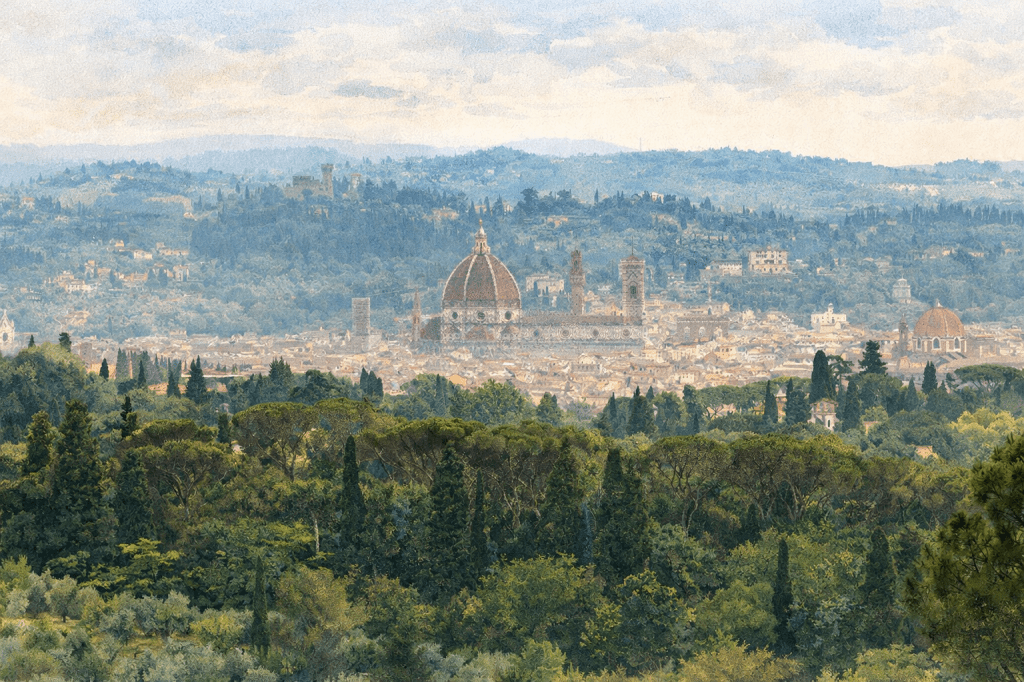
One of the most revealing ways to experience Florence is from the surrounding hills, particularly from Fiesole. From here, the city unfolds in its entirety: the dome of Santa Maria del Fiore, the river’s curve, and the dense weave of rooftops framed by distant hills.
This elevated perspective restores Florence to its geographical context, reminding visitors that the city is inseparable from the landscape that shaped it. A brief descent into the city allows for a walk, a coffee, and a moment of contact, without turning the stop into a race against time.
The Chianti and the Language of Wine
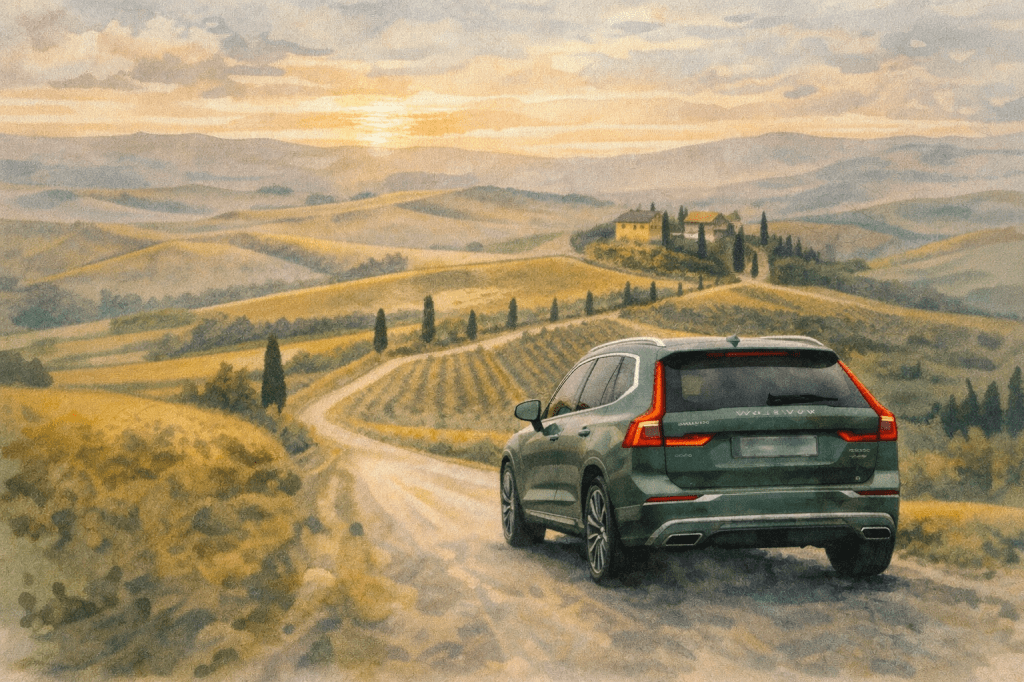
Leaving Florence, the route moves south through the Chianti, where the countryside becomes more intimate and rhythmical. Vineyards, cypress-lined roads, and stone farmhouses form a landscape deeply associated with Tuscan identity.
Here, wine culture is not an attraction but a structural element of the territory. Roads follow the contours of hills shaped by centuries of cultivation, and each village reflects a long-standing relationship between land and labor.
Monteriggioni and the Medieval Ring
Along the way stands Monteriggioni, encircled by remarkably intact walls. Small in scale but powerful in presence, Monteriggioni offers a concentrated image of medieval defense and community, rising from the surrounding fields like a stone crown.
A pause here reinforces the sense of continuity between countryside and settlement, reminding travelers how closely history and landscape are intertwined.
Siena and the Weight of History
Further south lies Siena, whose character contrasts sharply with Florence. Compact, vertical, and inward-looking, Siena expresses a different civic spirit, shaped by medieval rivalries and a strong sense of identity.
Even a brief encounter with Siena — walking toward the Piazza del Campo, sensing the density of its streets — adds depth to the journey, offering a counterpoint to the openness of the surrounding countryside.
San Gimignano and the Vertical Landscape
When time and conditions allow, the itinerary may include San Gimignano, whose towers rise above the landscape as markers of medieval ambition and wealth. Seen from a distance or approached briefly, San Gimignano contributes another distinctive layer to the Tuscan narrative, where architecture becomes part of the skyline itself.
A Journey Designed for Continuity
This itinerary is defined by flexibility. Depending on interests, timing, and light, emphasis may shift between cities, landscapes, and viewpoints. The possibility of ending the journey in Florence adds further adaptability, transforming a transfer into an experience rather than a necessity.
Within QuodLibet Private Journeys, the day is shaped to maintain balance: seeing much while traveling comfortably, allowing places to emerge through context rather than accumulation.
From Rome to Florence, through Arezzo, the Chianti, and Siena, this journey offers a broad yet coherent reading of Tuscany. It is a way of arriving that gives meaning to the distance, revealing how the spaces between cities often hold the key to understanding them.
What the Rome to Florence through Tuscany tour offers
- A private day trip from Rome for two guests
- Private transportation in a comfortable vehicle
- A Roman host who accompanies you throughout the day
- Flexibility and attention to rhythm rather than rigid schedules
Price
Full day tour: 900,00 EUR
The tour includes: transportation with driver, fuel and pay-tools costs. The tour does not include food, extra excursions and entrance tickets to attractions
Who the Rome to Florence private journey is for
This experience is ideal for couples and travellers who:
- value comfort, conversation and quiet moments
- enjoy iconic places when they can be experienced with time and perspective
 Quodlibet Private Journeys